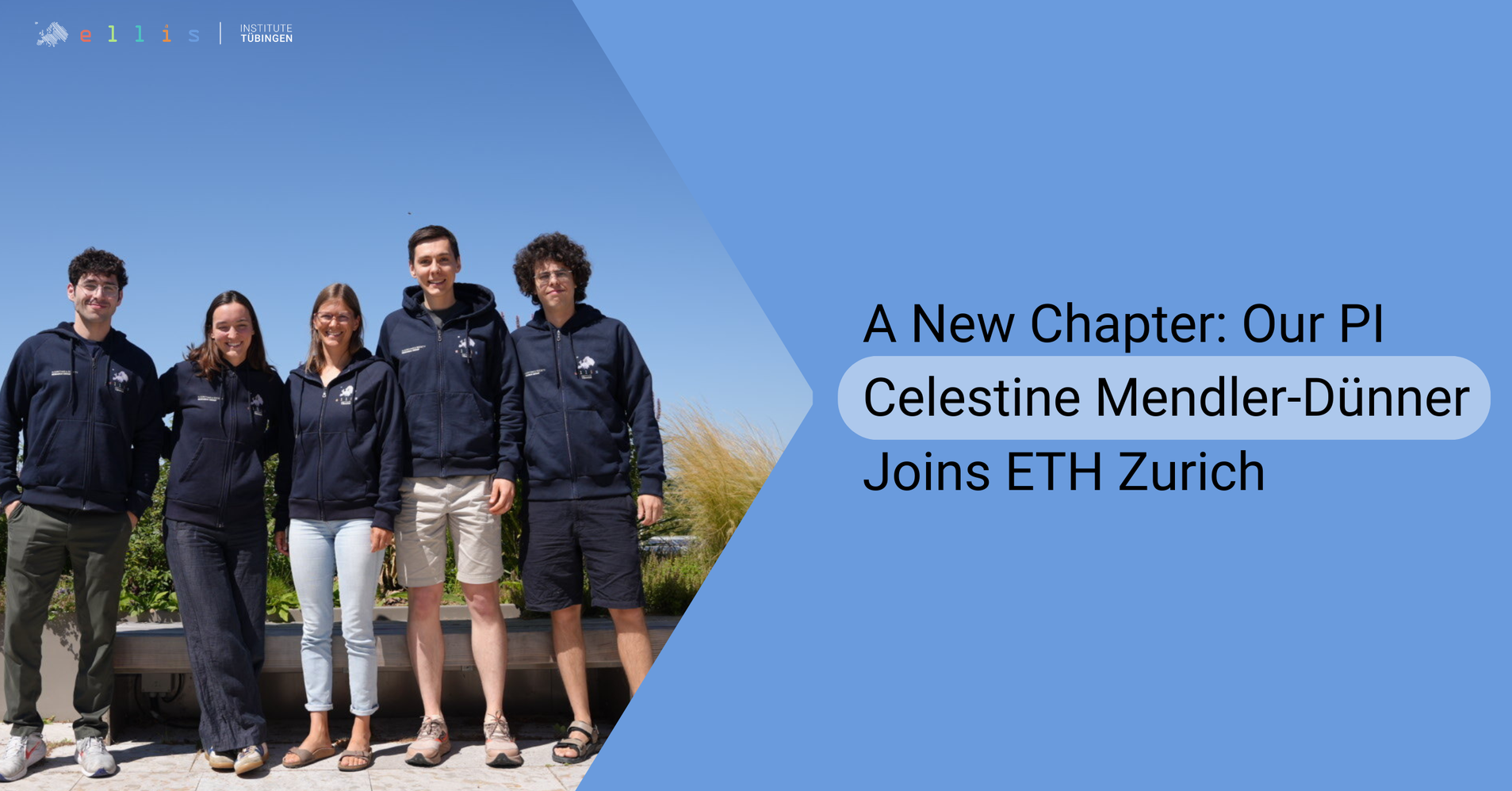

One of the ELLIS Institute Tübingen's founding principal investigators is taking the next step in a remarkable research career. This September, Celestine Mendler-Dünner leaves Tübingen to take up a professorship at ETH Zurich - a move that marks both a personal milestone and a testament to the kind of careers the ELLIS Institute Tübingen was created to make possible.
Celestine was among the very first PIs recruited when the Institute was launched in 2023. Joining an institute that did not yet fully exist was, for her, precisely the appeal. "As the first institute of its kind, the ELLIS Institute Tübingen promised to be something very special, and I did not want to miss the opportunity of being part of it," she recalls. "And this turned out to be an incredible journey."
The research
At the heart of Celestine's work is a simple but far-reaching idea: machine learning is never just a technical system — it is shaped by, and in turn reshapes, the people and societies around it. Her group, Algorithms and Society, studies learning systems as part of a broader sociotechnical ecosystem, examining how data-driven systems interact with human behavior — from small decision-support tools to recommender systems and digital platform markets — with social questions running throughout.
Among the first PIs
For Celestine, joining as one of the very first PIs meant helping to build the Institute from the ground up: facility, outreach, the internal processes that keep a research organization running. She remembers it as demanding but genuinely enjoyable work, carried by a team determined to make things possible as efficiently as they could. Looking back, she is "very proud of how the institute has grown and the visibility it has gained globally."
Freedom to pursue what matters
What made the environment distinctive, she notes, was the combination of full academic freedom and the financial means to pursue impactful research — a pairing hard to find elsewhere. That freedom let her and the wider Tübingen AI community keep social values at the centre of the work, pursuing questions of common good rather than only those that create immediate economic value. Centered within Tübingen's thriving AI ecosystem, the Institute gave her a compelling reason to continue her research career in Europe.
Looking ahead
The Institute's close ties to the Max Planck Institute for Intelligent Systems, the Tübingen AI Center, and the broader ELLIS Network allowed her to push the frontiers of research with minimal distraction — an invaluable asset, she says, at a pivotal stage of her career.
As she prepares for the move to ETH Zurich, Celestine is looking forward to the next chapter while holding on to what she found in Tübingen. "The ELLIS Institute Tübingen will always be a remarkable experience for my personal and professional career. I will deeply miss Tübingen," she says, "and I look forward to staying connected with the wonderful people I have met here."
As an Alumni PI, Celestine will indeed maintain close ties to the ELLIS Institute, where she will remain affiliated with the institute as a Hector Endowed Fellow for the next year.
Her journey — from one of the ELLIS Institute's first PIs to a professorship at one of Europe's leading universities — reflects exactly what the Institute set out to do: create the conditions for exceptional researchers to thrive, and to keep world-class AI talent in Europe. We congratulate Celestine warmly and wish her every success in Zurich.