Endowing a NAO Robot with Practical Social-Touch Perception
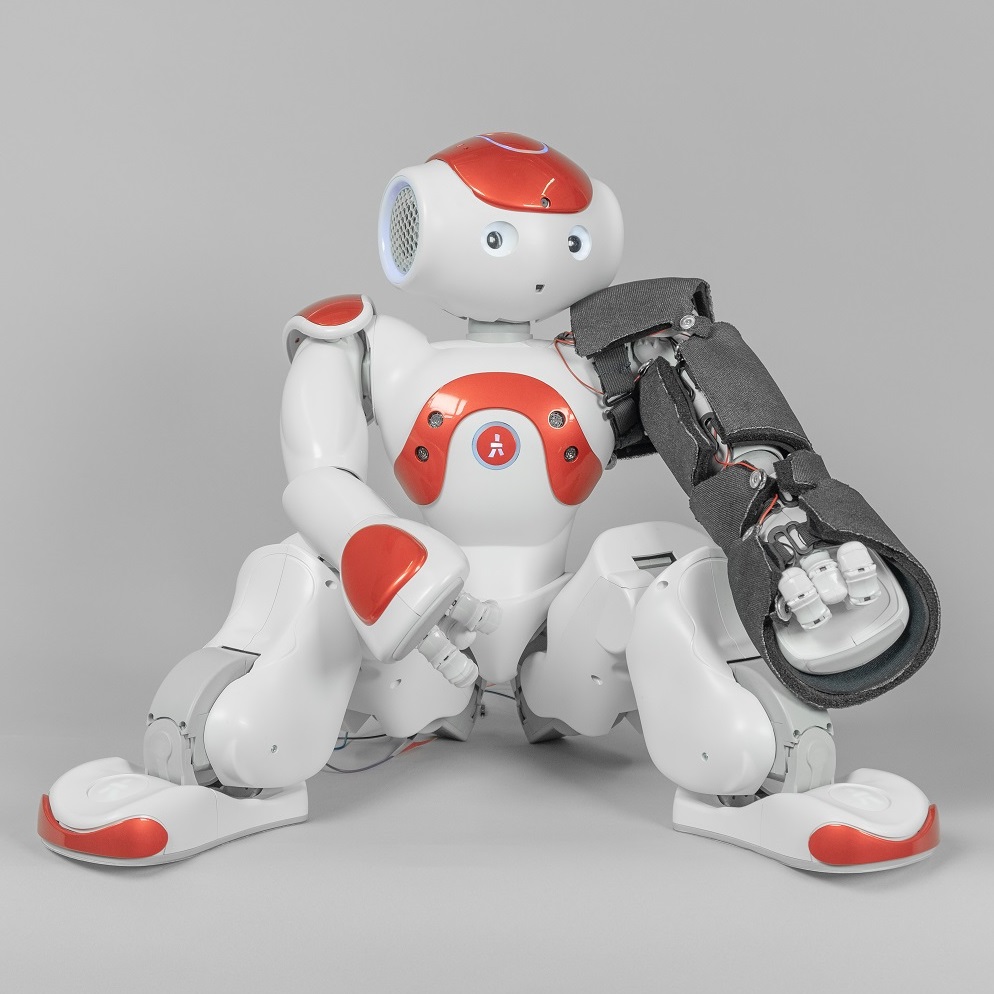
Social touch is essential to everyday interactions, but current socially assistive robots have limited touch-perception capabilities. Rather than build entirely new robotic systems, we propose to augment existing rigid-bodied robots with an external touch-perception system. This practical approach can enable researchers and caregivers to continue to use robotic technology they have already purchased and learned about, but with a myriad of new social-touch interactions possible. This paper presents a low-cost, easy-to-build, soft tactile-perception system that we created for the NAO robot, as well as participants' feedback on touching this system. We installed four of our fabric-and-foam-based resistive sensors on the curved surfaces of a NAO's left arm, including its hand, lower arm, upper arm, and shoulder. Fifteen adults then performed five types of affective touch-communication gestures (hitting, poking, squeezing, stroking, and tickling) at two force intensities (gentle and energetic) on the four sensor locations; we share this dataset of four time-varying resistances, our sensor patterns, and a characterization of the sensors' physical performance. After training, a gesture-classification algorithm based on a random forest identified the correct combined touch gesture and force intensity on windows of held-out test data with an average accuracy of 74.1\%, which is more than eight times better than chance. Participants rated the sensor-equipped arm as pleasant to touch and liked the robot's presence significantly more after touch interactions. Our promising results show that this type of tactile-perception system can detect necessary social-touch communication cues from users, can be tailored to a variety of robot body parts, and can provide HRI researchers with the tools needed to implement social touch in their own systems.





| Author(s): | Rachael Bevill Burns and Hyosang Lee and Hasti Seifi and Robert Faulkner and Katherine J. Kuchenbecker |
| Journal: | Frontiers in Robotics and AI |
| Volume: | 9 |
| Number (issue): | 840335 |
| Pages: | 1--17 |
| Year: | 2022 |
| Month: | April |
| Project(s): | |
| BibTeX Type: | Article (article) |
| DOI: | 10.3389/frobt.2022.840335 |
| State: | Published |
| Electronic Archiving: | grant_archive |
BibTeX
@article{Burns22-FRAI-Endowing,
  title = {Endowing a {NAO} Robot with Practical Social-Touch Perception},
  journal = {Frontiers in Robotics and AI},
  abstract = {Social touch is essential to everyday interactions, but current socially assistive robots have limited touch-perception capabilities. Rather than build entirely new robotic systems, we propose to augment existing rigid-bodied robots with an external touch-perception system. This practical approach can enable researchers and caregivers to continue to use robotic technology they have already purchased and learned about, but with a myriad of new social-touch interactions possible. This paper presents a low-cost, easy-to-build, soft tactile-perception system that we created for the NAO robot, as well as participants' feedback on touching this system. We installed four of our fabric-and-foam-based resistive sensors on the curved surfaces of a NAO's left arm, including its hand, lower arm, upper arm, and shoulder. Fifteen adults then performed five types of affective touch-communication gestures (hitting, poking, squeezing, stroking, and tickling) at two force intensities (gentle and energetic) on the four sensor locations; we share this dataset of four time-varying resistances, our sensor patterns, and a characterization of the sensors' physical performance. After training, a gesture-classification algorithm based on a random forest identified the correct combined touch gesture and force intensity on windows of held-out test data with an average accuracy of 74.1\%, which is more than eight times better than chance. Participants rated the sensor-equipped arm as pleasant to touch and liked the robot's presence significantly more after touch interactions. Our promising results show that this type of tactile-perception system can detect necessary social-touch communication cues from users, can be tailored to a variety of robot body parts, and can provide HRI researchers with the tools needed to implement social touch in their own systems.},
  volume = {9},
  number = {840335},
  pages = {1--17},
  month = apr,
  year = {2022},
  author = {Burns, Rachael Bevill and Lee, Hyosang and Seifi, Hasti and Faulkner, Robert and Kuchenbecker, Katherine J.},
  doi = {10.3389/frobt.2022.840335},
  month_numeric = {4}
}